
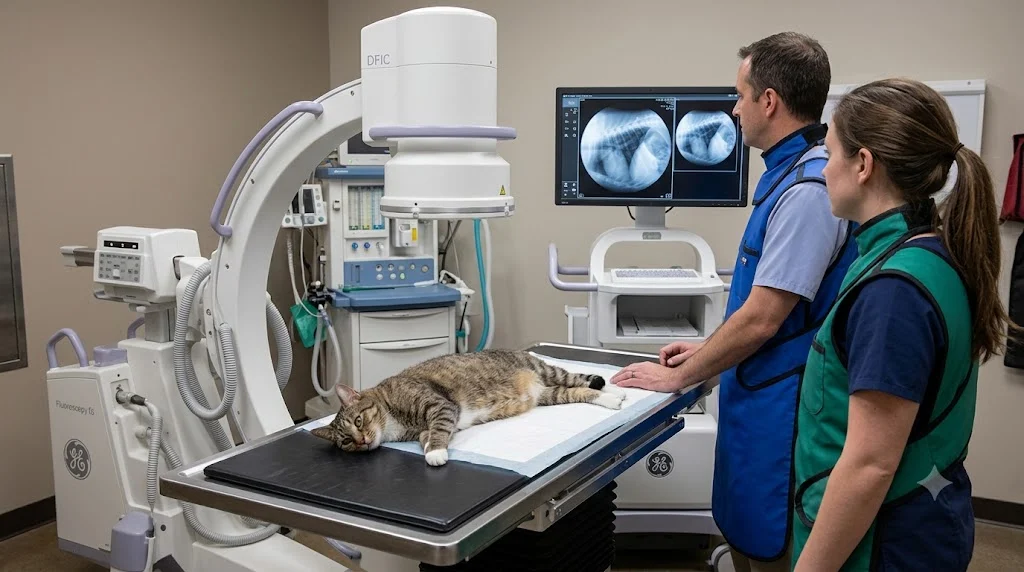
Seeing How Your Pet’s Body Moves in Real Time
Some problems only show up when the body is moving: a swallow that goes wrong, an airway that collapses with each breath, or a passage that narrows as food tries to pass through. At West Texas Veterinary Specialist in Lubbock, TX, fluoroscopy gives our board-certified specialists a live, moving X-ray view of these structures, helping us find answers that still radiographs can miss and plan treatment with greater precision for dogs and cats referred to our practice.
Book OnlineWhat Is Fluoroscopy?
Fluoroscopy is a form of X-ray imaging that produces a continuous, moving picture rather than a single still image. Instead of capturing a snapshot, it lets the specialist watch organs and structures as they work. This makes it especially useful for conditions that change with motion, such as swallowing, breathing or the movement of contrast material through the digestive or urinary tract.
Because the images appear on screen as the study happens, fluoroscopy can also be used to guide certain minimally invasive procedures, allowing the specialist to position instruments accurately without open surgery.
When Fluoroscopy May Be Recommended
Your primary care veterinarian may refer your pet for a fluoroscopic study when standard X-rays or an exam point to a problem that needs a closer, dynamic look. Common reasons include:
- Regurgitation, gagging or difficulty swallowing food or water
- Suspected esophageal problems, such as narrowing, poor motility or an enlarged esophagus
- Chronic coughing, honking or noisy breathing that may point to tracheal or airway collapse
- Evaluating the flow of contrast material through the digestive or urinary tract
- Guiding minimally invasive procedures, such as balloon dilation of a benign esophageal stricture
How Fluoroscopy Fits Into Your Pet’s Care
Fluoroscopy is often one piece of a broader diagnostic plan. Depending on what the study shows, our specialists may combine it with ultrasound, endoscopy or CT and advanced imaging to build a complete picture before recommending treatment. Every study is interpreted by a board-certified specialist who reviews the findings in the context of your pet’s history and symptoms.
A Referral-Based Approach
West Texas Veterinary Specialist is a specialty referral practice. Your family veterinarian remains part of your pet’s care team, and we work alongside them from the first consultation through follow-up. After the study, we explain what we found in clear terms, discuss the options with you, and send a detailed report back to your primary veterinarian so everyone stays informed.
What to Expect on the Day of the Study
Preparation depends on the type of study. Some fluoroscopic exams, such as swallowing studies, are often performed with the pet awake so normal swallowing can be observed, while others may require sedation or anesthesia for safety and image quality. Fasting may be needed beforehand. Our team will give you specific instructions ahead of time, and you can find general guidance on our Before Your Visit page.
Throughout the exam, radiation exposure is kept as low as possible while still producing the images needed, and your pet is monitored closely by our team.
Fluoroscopy FAQs
What is the difference between fluoroscopy and a regular X-ray?
A regular X-ray captures a single still image. Fluoroscopy uses continuous X-ray imaging to create a live, moving picture, so the specialist can watch processes like swallowing, breathing or the movement of contrast material as they happen.
Is fluoroscopy safe for my pet?
Yes. Fluoroscopy uses carefully controlled X-ray exposure, and our team keeps radiation as low as possible while still getting diagnostic images. For most pets, the value of an accurate diagnosis far outweighs the small amount of exposure involved.
Will my pet need sedation or anesthesia?
It depends on the study. Swallowing studies are often done while the pet is awake so normal swallowing can be observed. Other studies or fluoroscopy-guided procedures may require sedation or general anesthesia. We will explain what your pet needs before the appointment.
How should I prepare my pet for a fluoroscopy appointment?
Instructions vary by procedure, but fasting is commonly required beforehand. Our team will give you specific preparation steps when the appointment is scheduled, including guidance on food, water and any current medications.
Can fluoroscopy be used to guide treatment?
Yes. Because the images are live, fluoroscopy can guide certain minimally invasive procedures, such as balloon dilation of an esophageal stricture, helping the specialist position instruments accurately without open surgery.
How soon will I get the results?
Fluoroscopy produces images immediately, so our specialists can often share preliminary findings shortly after the study. A full report is then sent to you and your primary care veterinarian, along with recommended next steps.
Do I need a referral for my pet to have fluoroscopy?
We are a specialty referral practice, so most pets come to us through their primary care veterinarian. If you think your pet may benefit from fluoroscopy, talk with your family veterinarian or call our office at to learn how the referral process works.