
Helping Pets Swallow Comfortably Again
When a narrowed esophagus makes every meal a struggle, pets can lose weight quickly and become uncomfortable. At West Texas Veterinary Specialist in Lubbock, TX, our board-certified internal medicine specialist uses endoscopic balloon dilation to gently stretch benign esophageal strictures. This minimally invasive approach restores your pet’s ability to eat, usually with a short recovery and no surgical incision.
Book OnlineWhat Is a Benign Esophageal Stricture?
A benign esophageal stricture is an area of scar tissue that narrows the esophagus, the muscular tube that carries food and water from the mouth to the stomach. “Benign” means the narrowing is not caused by cancer. As the scar tissue tightens, food and sometimes liquids cannot pass easily, so swallowing becomes difficult or painful.
Strictures in dogs and cats most often develop after:
- Reflux esophagitis, including stomach acid reflux during or after anesthesia
- Pills or capsules that lodge in the esophagus, such as certain antibiotics
- Swallowing caustic substances or irritating chemicals
- A foreign object stuck in the esophagus, or its removal
- Prior esophageal surgery or trauma
Signs Your Pet May Have an Esophageal Stricture
Symptoms often appear one to several weeks after the initial injury, as scar tissue forms. Watch for:
- Regurgitating food shortly after eating, often undigested and tube-shaped
- Repeated swallowing, gulping, or stretching the neck while eating
- Drooling or signs of pain when swallowing
- Eagerness to eat followed by reluctance or walking away from the bowl
- Weight loss despite a good appetite
- Coughing or nasal discharge, which may signal aspiration pneumonia
If your pet shows these signs, talk with your primary care veterinarian. Regurgitation can lead to aspiration pneumonia, so early evaluation is important.
How Balloon Dilation Works
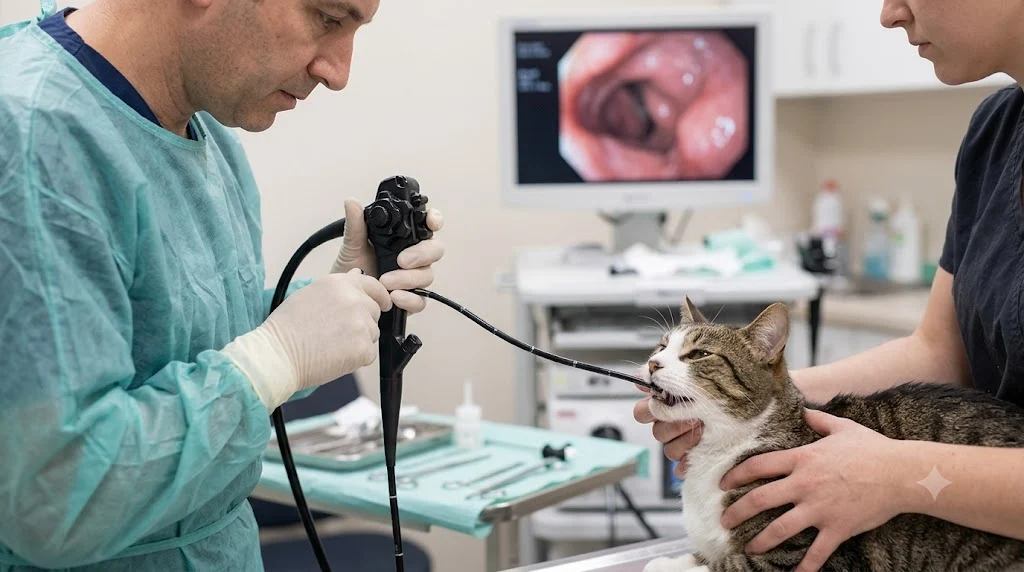
Balloon dilation is performed under general anesthesia using endoscopy, which lets our specialist see the inside of the esophagus directly. After confirming the location, length, and severity of the stricture, the specialist passes a small balloon catheter alongside the endoscope and positions it within the narrowed segment.
The balloon is then inflated with carefully controlled pressure to gently stretch the scar tissue. The procedure is often repeated with gradually larger balloons until the esophagus reaches a safe, functional diameter. Throughout the process, the specialist monitors the tissue on screen to reduce the risk of tearing.
Some pets improve after a single treatment. Many need a series of dilations, typically spaced several days to a couple of weeks apart, because scar tissue tends to contract again as it heals.
Why Specialty Care Matters for Esophageal Strictures
- Specialized equipment: Balloon dilation requires flexible endoscopes, dilation balloons in multiple sizes, and inflation devices that most general practices do not have on hand.
- Experienced judgment: Strictures vary widely in length, location, and severity. Choosing the right balloon size, inflation pressure, and number of dilations takes advanced training in handling delicate esophageal tissue.
- Ongoing management: Because strictures can recur, our specialist builds a follow-up plan that may include anti-reflux and protective medications, diet changes, and repeat dilations tailored to your pet.
Recovery and Aftercare
Most pets go home the same day or the following day. Your pet will usually start with soft, moist food offered in small, frequent meals, and may receive medications to reduce stomach acid, protect the esophageal lining, and manage discomfort. We stay in close contact with you and your family veterinarian to track progress and schedule any additional dilations.
West Texas Veterinary Specialist works on a referral basis. If your pet has been diagnosed with or is suspected to have an esophageal stricture, ask your veterinarian about a referral to our internal medicine service. Veterinarians can begin the process through our Refer a Patient page.
Esophageal Balloon Dilation FAQs
Is balloon dilation safe for dogs and cats?
Balloon dilation is considered a safe, minimally invasive treatment for benign esophageal strictures. As with any procedure, there are risks, including esophageal tearing and anesthetic complications. Performing the dilation under direct endoscopic visualization with gradually increasing balloon sizes helps keep those risks low.
How many dilation procedures will my pet need?
It varies. Some pets do well after one procedure, while many need several dilations spaced days to weeks apart. The number depends on the length, location, and severity of the stricture and how the tissue responds to treatment.
Will my pet need surgery instead?
Most benign strictures can be managed with balloon dilation, which avoids opening the chest or neck. Surgery is generally reserved for cases that do not respond to repeated dilations or that involve other complications.
How is an esophageal stricture diagnosed?
Diagnosis is usually based on your pet’s history and symptoms, imaging studies such as X-rays or a contrast swallow study, and direct examination of the esophagus with endoscopy. Endoscopy also confirms the stricture is benign and allows treatment during the same anesthetic event.
What should my pet eat after balloon dilation?
Pets typically start with soft, moist food or a gruel-like consistency fed in small, frequent meals. Our specialist will give you specific feeding instructions and let you know when your pet can gradually return to a normal diet.
Can an esophageal stricture come back?
Yes. Scar tissue can contract again as it heals, which is why repeat dilations are common. Medications to reduce reflux and inflammation, along with careful follow-up, help lower the chance of recurrence.
Do I need a referral to schedule balloon dilation?
Yes. West Texas Veterinary Specialist is a referral-based specialty practice. Ask your primary care veterinarian to refer your pet, and our team will coordinate the consultation and procedure with you and your veterinarian.
Get Your Pet Back to Comfortable Mealtimes
If swallowing has become a struggle for your dog or cat, our specialist can help. Ask your veterinarian about a referral to West Texas Veterinary Specialist, or call us at with questions. For more on referrals, scheduling, and what to expect, visit our Frequently Asked Questions.