
Detailed Answers When X-Rays Aren’t Enough
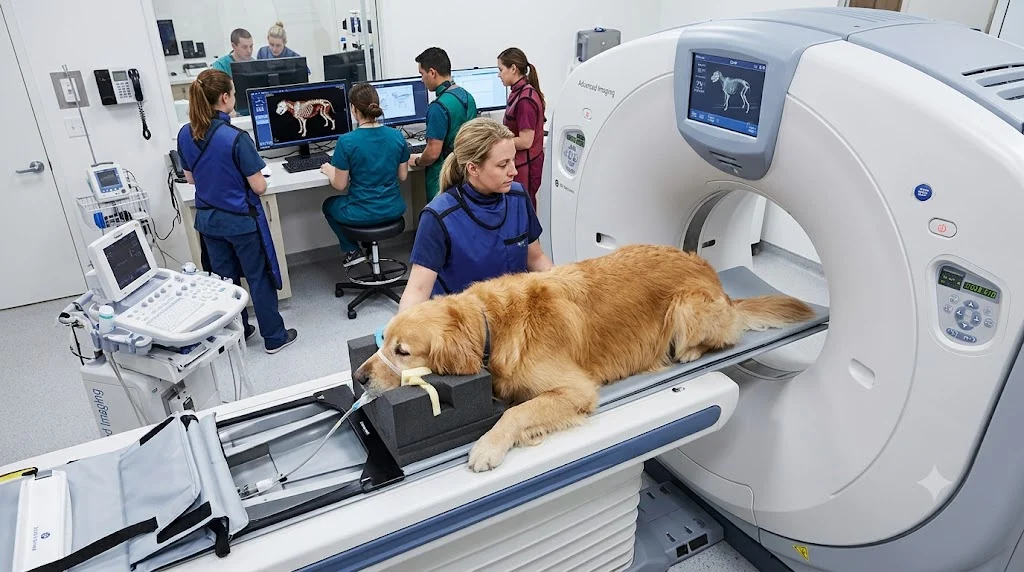
West Texas Veterinary Specialist is bringing 64-slice helical CT with 128-slice reconstruction to pets in Lubbock, TX and across West Texas. This scanner captures fast, high-resolution images of anatomy that standard radiographs can’t show clearly. Board-certified specialists review those images alongside your pet’s full medical picture, so the findings lead to a clear diagnosis and a focused plan for surgery, cancer care or other treatment. We work by referral from your primary veterinarian.
Book OnlineWhat Is a CT Scan?
Computed tomography (CT) uses X-rays and computer processing to create detailed cross-sectional images of the body. A traditional radiograph shows the body in two dimensions, so organs, bones and soft tissues overlap in a single picture. CT captures the body in thin slices instead. This lets a specialist examine one structure at a time and see exactly where an abnormality sits and how far it extends.
The images can also be rebuilt in multiple planes and in three dimensions (3D). This is especially useful when a surgeon is planning a complex procedure or an oncologist needs to measure a tumor and map the tissue around it.
Advanced CT Technology for West Texas Pets
Our 64-slice helical CT scanner with 128-slice reconstruction is a major step forward for veterinary imaging in the region. Until now, many families in Lubbock, the South Plains and the Panhandle have had to travel long distances for this level of imaging.
Because the scanner acquires images rapidly, scans are short. Its high-resolution reconstruction shows small or hard-to-see structures in fine detail. With this information, our team can:
- Pinpoint the location and extent of disease
- Tell masses, fluid and normal tissue apart
- Plan surgical, oncologic and minimally invasive procedures with greater precision
- Reduce guesswork before deciding on next steps in care
When Is CT Recommended for Dogs and Cats?
CT can provide valuable information for many medical and surgical conditions. Common reasons for a CT referral include:
Head and Airway
Chronic nasal discharge or bleeding, nasal masses, skull and facial abnormalities, middle and inner ear disease, and airway disorders.
Chest and Abdomen
Lung nodules and masses, thoracic abnormalities, abdominal masses, vascular abnormalities such as shunts, and selected organ and soft-tissue disorders.
Orthopedic and Neurologic
Complex fractures, bone lesions, joint abnormalities, spinal disease, and planning for orthopedic surgery.
Cancer Evaluation
Characterizing masses, determining how far disease has spread, selected screening for metastasis, and planning treatment or surgery with our veterinary oncology team.
The right imaging study depends on your pet’s condition. Your veterinarian and our specialists will help decide whether CT, ultrasound or another test is best suited to answer the clinical question.
CT as Part of a Complete Diagnostic Plan
CT produces remarkable images, but the images alone are only part of its value. Findings have to be interpreted in light of your pet’s history, physical exam, lab work and other diagnostic results. That context determines what an abnormality means and how it should shape the next steps in care.
Our specialists use CT alongside our other services. For example, a scan can guide a biopsy, help plan a procedure with our veterinary surgical team, or add to an internal medicine workup that already includes ultrasound or endoscopy.
What to Expect on the Day of Your Pet’s CT
Most pets need sedation or general anesthesia for CT. A pet must stay completely still to produce diagnostic-quality images. We tailor the anesthetic protocol to your pet’s age, health and the type of study being performed.
Depending on the area being evaluated, we may give intravenous contrast. Contrast makes blood vessels, organs, masses and other soft tissues easier to see.
The scan itself often takes only seconds to a few minutes. Preparation, sedation or anesthesia, contrast when needed, and recovery all add time, so your pet will stay with us longer than the scan itself. Before the appointment, we will give you specific fasting and preparation instructions.
A Collaborative, Referral-Only Approach
West Texas Veterinary Specialist is a referral-only outpatient specialty center. Your veterinarian may refer your pet specifically for CT, or our specialists may recommend CT as part of a broader specialty evaluation. We share imaging findings and recommendations with your primary veterinarian so the results fit directly into your pet’s ongoing diagnostic and treatment plan. Veterinarians can start the process through our Refer a Patient page.
Questions About CT Scans for Pets
Why might my pet need a CT scan?
CT may be recommended when more detail is needed than radiographs can provide, or when an abnormality is in an area well suited to cross-sectional imaging. It is commonly used to evaluate the head, nasal passages, chest, bones, joints, spine, masses and other complex anatomy.
What is the difference between CT and a regular X-ray?
A radiograph is a two-dimensional image in which structures overlap. CT creates thin cross-sectional slices so each structure can be evaluated on its own, and the images can be reconstructed in multiple planes and in 3D.
What makes your CT scanner different?
Our center uses a 64-slice helical CT scanner with 128-slice reconstruction, one of the most advanced veterinary CT systems available in West Texas. Its speed and high resolution provide exceptional detail for complex diagnoses and for surgical and procedural planning.
Will my pet need anesthesia or contrast?
Most pets need sedation or general anesthesia to stay perfectly still during the scan. Some studies also use intravenous contrast to highlight blood vessels, organs and masses. Both decisions depend on your pet’s condition and the question the scan needs to answer.
How long will my pet’s CT appointment take?
The scan itself is usually very quick. Preparation, sedation or anesthesia, contrast when needed, and recovery add time. Our team will give you an expected schedule based on the study your pet needs.
Can my pet go home the same day?
Yes. Most pets go home the same day once they have recovered from sedation or anesthesia. We are an outpatient specialty center and do not provide overnight hospitalization or intensive care.
How will I receive the results?
We send CT findings and recommendations to your referring veterinarian, who will work them into your pet’s diagnostic and treatment plan. How long final results take depends on the type and complexity of the study.