
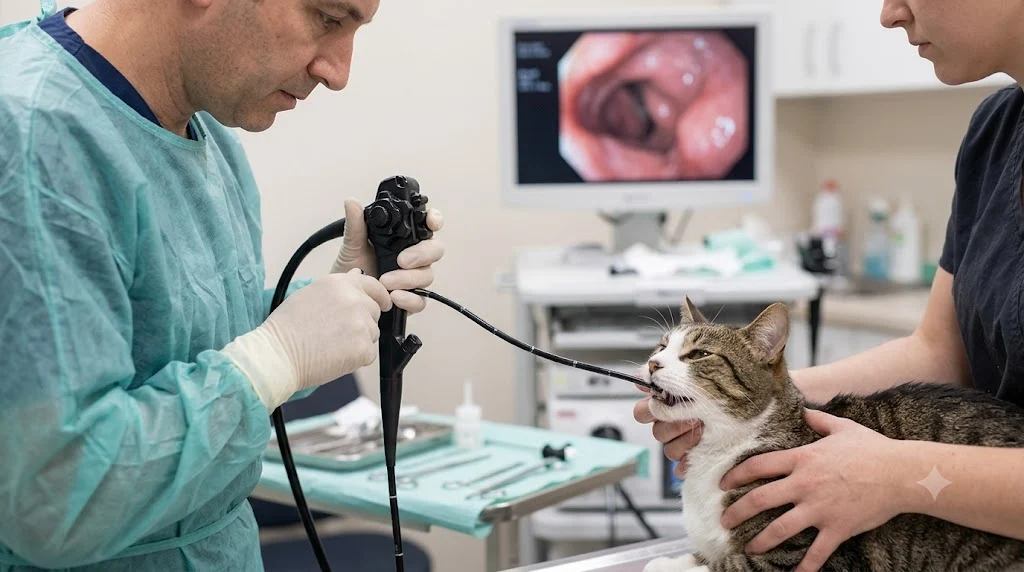
Finding the Cause of Chronic Sneezing and Nasal Discharge
At West Texas Veterinary Specialist in Lubbock, TX, our board-certified internal medicine specialists perform rhinoscopy, a minimally invasive endoscopic procedure that lets us look directly inside your pet’s nasal passages and the back of the throat. When sneezing, nasal discharge, nosebleeds or noisy breathing don’t improve with standard treatment, rhinoscopy helps us find the cause and collect samples, and in some cases remove the problem during the same visit.
Book OnlineWhat Is Rhinoscopy?
Rhinoscopy uses a small, specialized camera called a rhinoscope to examine the nasal cavity in detail. The scope is passed through the nostrils to view the front of the nasal passages. A flexible scope can also be turned back behind the soft palate to see the nasopharynx, the area where the nose meets the throat. Many problems develop there, and it can’t be seen during a routine exam.
Because the specialist sees the tissue directly, rhinoscopy can show inflammation, infection, polyps, tumors, foreign material and other changes that may not appear clearly on x-rays. In West Texas, grass awns and plant debris are a common reason for one-sided nasal discharge and sudden, violent sneezing. Rhinoscopy is often the best way to find these objects and retrieve them.
Common Reasons for Referral
Most general practice veterinarians refer a patient for rhinoscopy when nasal symptoms continue despite medical treatment, or when imaging suggests a more complex problem. Common reasons for referral include:
- Chronic nasal discharge, especially if it is bloody or comes from one side
- Persistent sneezing, reverse sneezing or congestion
- A suspected nasal foreign object, such as a grass awn
- Recurrent upper respiratory infections or infections that don’t resolve
- Suspected nasal masses, polyps or tumors
- Unexplained nosebleeds, noisy breathing or difficulty breathing through the nose
What to Expect During the Procedure
Rhinoscopy is performed under general anesthesia. This keeps your pet comfortable and still while we examine the delicate nasal structures. Before the procedure, your pet’s history, bloodwork and any previous imaging are reviewed so we can plan the safest approach. Advanced imaging of the nasal cavity, such as CT, may be recommended beforehand to map the area and guide where we look and sample.
During rhinoscopy, the specialist examines both nasal passages and the nasopharynx. Tissue biopsies, fluid samples or cultures can be collected for laboratory testing. If foreign material is found, it can often be removed through the scope during the same procedure, so your pet doesn’t need a separate surgery.
Why Rhinoscopy Matters for Diagnosis
Many nasal diseases look alike from the outside. A pet with chronic discharge could have a fungal infection, inflammatory rhinitis, dental disease affecting the nasal cavity, a foreign body or a tumor, and each of these needs a different treatment. Direct visualization combined with biopsy results gives a clear diagnosis, so treatment can be targeted rather than based on trial and error. Rhinoscopy is one of many diagnostic procedures offered through our veterinary internal medicine service.
Recovery After Rhinoscopy
Most pets recover quickly from anesthesia and go home the same day. A small amount of nasal discharge, mild bleeding or sneezing is common for a short time afterward. Our team will give you clear home-care instructions and tell you which signs mean you should call. When biopsy and culture results are available, the findings are shared with you and your primary veterinarian, and we work together on the best treatment plan for your pet.
A Referral-Based Specialty Service
Because rhinoscopy requires specialized equipment, anesthesia support and advanced training, it is performed by a board-certified internal medicine specialist. If your pet has ongoing nasal symptoms, ask your primary care veterinarian about a referral to West Texas Veterinary Specialist. For more on referrals, scheduling and what to expect, visit our Frequently Asked Questions page or call .
Rhinoscopy FAQs
Is rhinoscopy painful for my pet?
Rhinoscopy is performed under general anesthesia, so your pet does not feel the procedure. Afterward, most pets have only mild irritation, such as sneezing or slight nasal discharge, for a short time.
How long does rhinoscopy take?
The procedure itself usually takes under an hour, depending on what is found and whether biopsies or foreign body removal are needed. Your pet will spend additional time being prepared for anesthesia and recovering before going home.
Can rhinoscopy remove a foreign object from my pet’s nose?
Yes, in many cases. Grass awns, plant material and other debris can often be located and retrieved through the scope during the same procedure, which avoids the need for a separate surgery.
Why does my pet need rhinoscopy if x-rays were already taken?
X-rays show bone and air spaces but often can’t reveal small foreign objects, early tumors or inflammation of the nasal lining. Rhinoscopy lets the specialist see the tissue directly and collect biopsies for a definitive diagnosis.
Will my pet need CT before rhinoscopy?
CT is often recommended before rhinoscopy because it shows the full extent of nasal disease and helps guide where to look and take samples. Your specialist will discuss whether advanced imaging is right for your pet’s case.
When will we get the results?
What the specialist sees during the procedure is often discussed the same day. Biopsy and culture results from the laboratory typically take several days, and the findings are shared with you and your primary veterinarian.
Do I need a referral for rhinoscopy?
Yes. Rhinoscopy at West Texas Veterinary Specialists is provided through referral from your primary care veterinarian, who will send your pet’s history and any previous test results so we can plan the procedure.